
Visiting Isola Bella from Taormina: how to get there, what to see and when to go
Taormina and Isola Bella face each other just a few kilometres apart: the town above, clinging to the rock, and the bay below, where a small, green-covered islet lies only a few metres from the shore. Anyone arriving from eastern Sicily or travelling along the Ionian coast finds a fairly rare combination: a well-developed historic centre, a small nature reserve just underneath it and a network of connections that allows you to get from the main street down to the beach in roughly half an hour.
For most travellers planning a trip, Isola Bella naturally ends up on the list of things to see in Taormina; what really makes the difference are the times of day you choose and how you fit movements together: cable car, buses, a few walking stretches, sea conditions, and your willingness to go down during peak hours or instead look for quieter moments. It is not a remote or difficult place to reach, but an area that, especially in summer, requires a minimum of planning if you want to avoid unnecessary queues and an overcrowded beach.
Taormina and Isola Bella: where they are and what they are like
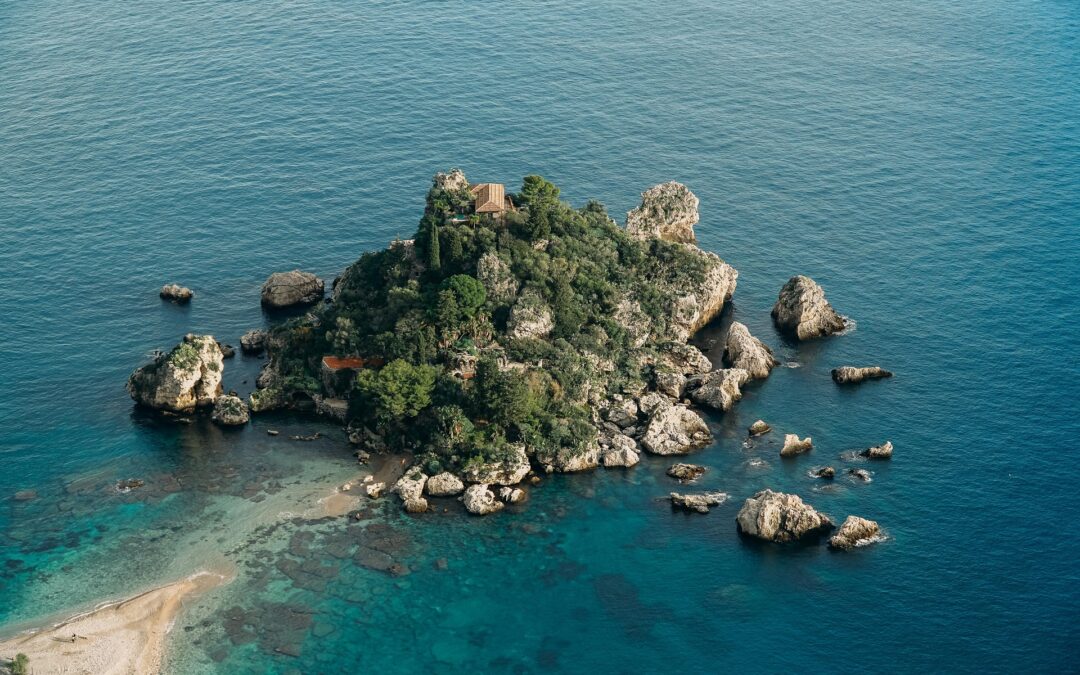
Isola Bella lies along Sicily’s Ionian coast, between Giardini Naxos and Letojanni, directly below the slope on which Taormina stands. The bay takes its name from the islet at its centre which, seen from above, appears as a patch of vegetation linked to the shore by a strip of pebbles whose width changes according to the sea level and wave conditions. Just behind the beach run State Road 114 and the railway line, with trains travelling parallel to the coast.
The town itself sits on a higher level: Corso Umberto, Piazza IX Aprile, the Ancient Theatre and the public gardens all lie on this upper terrace. Vehicle access is regulated, cars are left in multistorey car parks and people move around mostly on foot. The connection with the sea, in this context, is not immediate but goes through a series of intermediate levels: the cable car down to Mazzarò, a few access roads for vehicles and the viewpoint on Via Pirandello, from which a path with steps leads down towards Isola Bella.
From an administrative point of view, the islet and a stretch of surrounding sea form part of a regional nature reserve, created in the late 1990s and now included in the Naxos Taormina Archaeological Park. This entails controlled access, staff on site, restrictions on building and on certain activities, as well as specific attention to the vegetation, wildlife and historic structures on the island.
The history of Isola Bella
The story of Isola Bella begins in the Bourbon era and spans two centuries of changes in ownership, private projects and public interventions. In 1806 Ferdinand I of Bourbon donated the islet to the Municipality of Taormina, which thus became its formal owner. Towards the end of the nineteenth century, around 1890, the island was purchased by the English noblewoman Florence Trevelyan for a sum contemporary sources put at around 14,000 lire.
Florence Trevelyan, connected to the British court and relocated to Sicily after being distanced from that environment, settled in Taormina and married the doctor Salvatore Cacciola. A keen botanist, she used Isola Bella as both a holiday retreat and a place to experiment with new plant species: she had a small house built there and introduced exotic plants which, over time, blended with the pre-existing Mediterranean scrub, creating the mixture of vegetation that still characterises the islet today.
After her death, the island passed to her nephew, the lawyer Cesare Acrosso, who sold it to the Lo Turco family. In 1938 it was bought by the Bosurgi family from Messina, industrialists in the citrus-processing sector with the Sanderson company. During this period several residential units were built, partly carved into the rock and linked by stairways and terraces, with the intention of integrating the buildings into the vegetation. Many of these spaces now form part of the natural history museum route.
The bankruptcy of Sanderson in the early 1980s led to the island being auctioned off and to a period of neglect: the area was poorly maintained, some structures were damaged and the vegetation was no longer managed with any regularity. In 1984 the Region of Sicily declared Isola Bella a site of historical and artistic interest, recognising its value from both a natural and cultural point of view. In 1990 the Regional Department of Cultural Heritage formally acquired it, and in 1998 the nature reserve was established, initially entrusted to WWF and later to CUTGANA and the Naxos Taormina Archaeological Park.
With the creation of the Regional Natural History Museum, the islet became fully integrated into a system of regulated visits: limited-capacity admissions, defined internal routes, seasonal opening hours and ticketing that includes standard tickets, reduced rates and concessions for local residents. This framework helps maintain a balance between tourism and conservation, especially given the presence of sensitive plant and animal species.
What to see and do on Isola Bella
From a practical standpoint, a visit to Isola Bella breaks down into three main components: spending time on the beach and in the bay, accessing the islet and its natural history museum if you wish, and taking part in sea-based activities such as boat trips. Depending on how much time you have, you can focus solely on the bathing side or set aside a few hours for the more naturalistic and museum elements as well.
The beach is entirely made up of pebbles, ranging from larger stones to fine gravel, so it is often useful to bring sandals or water shoes. The seafront is partly occupied by beach clubs, such as Lido Mendolia, Lido Pizzichella and Lido La Plage, which offer umbrellas, sunbeds and basic services, and partly by sections of free beach. The choice between the two depends largely on how long you plan to stay and whether you need services close at hand, bearing in mind that in peak season free areas tend to fill up quickly, often by mid-morning.
Access to the islet is via the pebble spit that links it to the mainland. On calm days this spit is clearly visible and easy to cross; when the sea is rough or the water level higher, it narrows and can require a little more care. Once on the island, visitors follow a marked route that leads through vegetation, terraces and structures created by past owners, and up to a few viewpoints over the bay and the coastline. Entry is managed through set time slots and small groups, with a maximum number of people allowed at any one time to prevent overcrowding.
The natural context includes Mediterranean scrub coexisting with exotic species introduced in the Trevelyan period, wildlife that includes seabirds using the islet as a resting and nesting area, and an endemic lizard, Podarcis sicula medemi, for which specific conservation measures have been adopted. Limits on night-time lighting and restrictions on the number of simultaneous visitors are part of this protection strategy.
On the opposite side, along the coast, the presence of Villa Caronia and its terraced garden adds another point of interest: the terraces, olive trees and various plant species provide a different way of reading the bay, with a viewpoint that encompasses Capo Taormina, Giardini Naxos and Isola Bella. Boat excursions, finally, are offered by several local operators, either from the area around Isola Bella or from Giardini Naxos, with routes that typically include the Grotta Azzurra, the Grotta della Conchiglia and stretches of coastline towards the Bay of Naxos.
Taormina cable car and links to the bay
The Taormina–Mazzarò cable car is the most widely used link between the town centre and the coastal strip. The departure station is on Via Pirandello, a few minutes’ walk from Porta Messina, while the arrival station is located above Mazzarò, close to the beach access points. The journey takes around three minutes and the service runs frequent trips, with extended hours during the summer months.
For those staying in the town centre, the cable car is often the simplest option: it avoids driving along the coastal road and having to find parking, and it makes travel times fairly predictable. The classic combination for visiting Isola Bella is cable car to Mazzarò and then a short walk along the road to the staircase leading down to the bay. On very busy days it is advisable to allow for some extra time in case of queues, especially in late morning and early afternoon.
Scheduled maintenance closures are announced in advance, but strong winds or technical issues can still lead to temporary suspensions. In such cases it is useful to have an alternative ready – whether a bus or a taxi – particularly if you need to be back in Taormina by a specific time.
How to get to Isola Bella and when to go
Anyone wondering how to reach Isola Bella from Taormina has four main options. The first is the cable car, which remains the most practical solution for those starting from the town centre. Once you arrive in Mazzarò, you walk the short stretch of road to the start of the staircase down to the bay; the remaining difference in height is modest and the route is manageable for anyone without specific mobility issues.
The second option is the footpath from the viewpoint on Via Pirandello. From this panoramic terrace, a stepped path descends towards State Road 114 near the entrance to the Isola Bella staircase. The way down is fairly straightforward, while the climb back up is more demanding, especially on hot days. This route appeals to those who prefer to avoid mechanical transport and want to include the descent to the sea as part of a walk.
The third possibility is the local bus service running from the Taormina terminal down to Mazzarò and the Isola Bella area. The journey takes about ten minutes, return tickets are reasonably priced and the stops are located close to the beach access points. It is an effective option when the cable car is suspended or very crowded, provided you keep an eye on the timetable for the last bus back.
Lastly, there is the private car, often used in combination with taxis. Driving is generally discouraged during peak summer weeks: parking spaces near the bay are limited and fill up quickly, the access road is narrow and manoeuvring vehicles looking for a space often causes traffic jams. A short taxi ride between Taormina and the Isola Bella area, on the other hand, has a relatively modest cost over such a short distance and can be useful when travelling with luggage or children.
Choosing when to visit Isola Bella depends on a mix of factors: weather, sea conditions, visitor numbers and the status of the reserve. From a climatic point of view, the period from late spring to early autumn offers the best conditions for swimming and spending time on the beach. July and August coincide with the highest visitor numbers, while May, June and September often provide a better balance between temperature and crowd levels.
It is important to check whether any works or maintenance are underway in the reserve during the chosen period, because in some cases access to the islet may be restricted or suspended even though the beach remains open. Official communications from the Naxos Taormina Archaeological Park and the Region of Sicily are the main reference for this type of information.
Within a single day, the time of visit has a strong impact on the experience. Early morning usually brings a quieter bay and more manageable temperatures in summer, while the middle of the day sees the highest concentration of visitors, especially when organised groups arrive. Late afternoon often works well for those who want to combine a swim and some time on the beach with a cable-car ride back and an evening in Taormina, without having to rush.

Ciao Sono Iolanda, Nel 2010 ho deciso di ritornare nella mia magica isola, la Sicilia, affinchè l’esperienza acquisita negli anni precedenti prendesse forma lì dove ero nata.
Link Utili
Dove si trova
Come raggiungerla
Numeri utili
Mappa di Siracusa
Esperenze culinarie Sicilia

Cosa fare a Cefalù

Escursioni Etna
Cosa Vedere a Catania
canoli-ricotta-cheese
esperienze a taormina

Escursioni
VIVI LE PIU’ BELLE ESPERIENZE IN SICILIA, ABBIAMO SELEZIONATO PER VOI LE PIU’ BELLE ESCURSIONI PRESENTI IN SICILIA.

Alloggi
CERCHI UN HOTEL DI LUSSO, CASALI ESCLUSIVI, VILLA CON PISCINA O B&B? SCEGLI L’ALLOGGIO PIU’ ADATTO A TE

Noleggio auto
IL NOLEGGIO DI UN’AUTOMOBILE IN SICILIA È IL MODO MIGLIORE PER SCOPRIRE LE PRINCIPALI BELLEZZE DELLA REGIONE SENZA ALCUN VINCOLO

Noleggio scooter
NOLEGGIARE UNO SCOOTER IN SICILIA PERMETTE DI VIVERE UN’ESPERIENZA UNICA, UNA VACANZA RICCA DI RICORDI


